
MAS 2025 Conference Program
Montana Archaeological Society
Annual Conference 2025
Welcome to the 64rd annual meeting of the Montana Archaeological Society in the Depot Center, Livingston, Montana.
2025 Program Activities and Abstracts
Friday, April 11 MORNING Museum Tour, Fieldtrip, and Film Screening
Fort Parker-Ground Penetrating Radar Demonstration with Dr. Ethan Ryan
9:00 am to 12:30 pm
Dr. Ethan Ryan will lead a Ground Penetrating Radar demonstration at Fort Parker, the First Crow Agency. The First Crow Agency is just nine miles east of Livingston, along Mission Creek. The Agency was constructed 1869 and functioned until 1875. The tour will leave the Depot Center parking lot at 9:00 AM. Those wishing to take the tour should meet at the parking area by 8:45 AM. Four-wheel drive or high clearance vehicles are recommended because the Mission Creek Road can be exciting when muddy. We will re-group at the Mission Creek exit before proceeding to Fort Parker. Parking is limited so try to carpool.
Yellowstone Gateway Museum Collections Tour
10:00 am to 12:30 pm
Museum Director Mark Brammer will lead a tour at the Yellowstone Gateway Museum in Livingston (admission will be free to MAS attendees). The Yellowstone Gateway Museum hosts a large collection of important historic and precontact collections and archive materials from across Montana. Those attending the tour will be able to view and a peruse materials on display, as well as work with Mr. Brammer to view materials of individual interest. This will be a great opportunity for local archaeologists and avocational archaeologists to see the rich history of Park County, MT. The tour attendees can arrive at the museum anytime between 10:00 AM – 1:00 PM, during that time frame Mr. Brammer has set aside his schedule to work with MAS attendees. Those wishing experience the entire tour should meet at the museum by 10:00 AM. It is also just a few blocks walk from the Depot Center. The Museum will provide free admission to all MAS attendees during the conference (April 11-12, 2025).
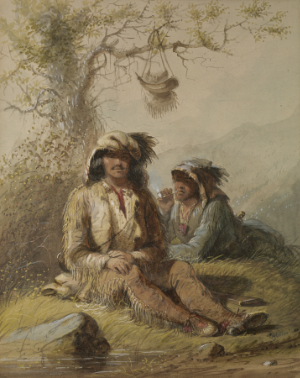
John Colter Film: The Life & Legend of John Colter
11:00 am to 1:00 pm
Screening of documentary: The Life and Legend of John Colter.
Dan Smith will be showing his new film in the Depot Center-Main Room.
I’m excited to release my new film, The Life and Legend of John Colter, as told by interpretive guide and storyteller Ken Sinay. The story has been told many times in film and around the campfire. However, you’ve never heard nor seen it told like this before: The drama, the thrill of life and death, the imagination of a generation all wrapped up in the masterful storytelling of Ken Sinay and illustrated by the classic western painters of early nineteenth century life… including Alfred Jacob Miller, Carl Bodmer, George Catlin, Charlie Russell and Albert Bierstadt.
Interpretive Guide Ken Sinay will be available for a discussion after the film!
Friday, April 11 AFTERNOON MEETINGS
General Member/Board Meeting in the Depot Center-Main Room
General Member Meeting: 1:30 pm to 3:00 pm
The MAS Board Meeting: 3:00 pm to 4:00 pm
Break
4:00 pm to 5:00 pm
EVENING SOCIAL AND AUCTION
5:30 pm to 9:00 pm
Catch up with friends and colleagues and participate in the auction. Cash bar and free hors d’oeuvres. Reception will be in the Depot Center.
Silent and Live Auctions will run from 6-8 pm.
Saturday, April 12 PRESENTATIONS
The Depot Center-Main Room
9:00 am to 9:10 am- Welcome and Opening Remarks (MAS President-Scott Dersam)
9:10 am to 9:30 am
Surprising and Unintended Consequences of Managing Cultural Resources: Rehabilitation of Two Historic Homesteads; Granite County Montana.
C. Milo McLeod (US Forest Service (Retired)
In 1979 the Lolo National Forest purchased 320 acres in the Upper Rock Creek drainage, Granite County, Western Montana. The 320 acres incorporated two patented homestead claims (Hogback Homestead and Morgan-Case Homestead) both with standing architecture. In 1990, Missoula Ranger District began rehabilitation of the Hogback Homestead to preserve and interpret its historic values. However, the homestead era improvements overlay a significant pre-contact archeological site (dating from 10,000 BP through the historic period), which required completion of an extensive data recovery effort. Personnel recovered nearly 4,000 artifacts prior to earth moving activities necessary to restore the homestead dwelling and improve access to the site. The Morgan Case Homestead was settled in the late 1880s by an African American woman originally from Maryland. In 2000 the Missoula Ranger District began rehabilitating the site, with the intention of preserving and interpreting its history. Six years into the project, the Region 1 Preservation Team leader found a cache of artifacts associated with Hoo Doo healing, which originated in West Africa. Similar artifact caches have been found in the Southeast and as far west as Texas, but prior to the discovery at Morgan-Case, none had been found in the northern tier of the US.
9:30 am to 9:50 am
Understanding the ancient role of moose in Rocky Mountain ecosystems.
William Taylor, Jon Dombrosky, Emily Lena Jones, John Wendt, Chance Ward, Russell Graham, and Joshua H. Miller.
Although moose have become an iconic symbol of contemporary Rocky Mountain ecosystems, their prehistory in much of North America is poorly understood. Pleistocene environments in the continent included the large stag-moose or Cervalces, which apparently went extinct in tandem with climate warming after the Last Glacial Maximum. Also likely during this period, the Eurasian moose, Alces, dispersed into the continent, where it eventually became a key part of local ecosystems. The scarcity of moose remains in the archaeofaunal and fossil records, difficulty in distinguishing the post-cranial morphology of these two taxa, and the lack of reliably dated or identified assemblages obscures a robust understanding of their Late Pleistocene and Holocene paleoecology. A brief glance at available historical records reveals issues with reliability of written sources in documenting historical populations but raises the possibility of a deeper history in many regions. As changing moose populations present conservation and wildlife management challenges throughout the Rocky Mountains, a careful interdisciplinary approach to reconstructing prehistoric biogeography and ecology of moose – by integrating information from fossil bones and biomolecules with Indigenous knowledge – is a pressing task for informed ecological decision-making in parks and public or private lands.
9:50 am to 10:10 am
An Update on University of Montana Archaeological Research in Yellowstone National Park
Douglas MacDonald (University of Montana) and Beth Horton (Yellowstone National Park)
In 2024, the University of Montana (UM) completed its 18th consecutive summer of archaeological research in Yellowstone National Park (YNP). In previous years, UM worked in many different areas of the park, including Yellowstone Lake, the Hayden Valley, Lamar Valley, and the Gallatin Mountains, among many others. UM’s 2024 work included archaeological survey of well-used backcountry trails in the vicinity of the Norris Geyser basin and Obsidian Cliff. Students in an archaeological field school identified pre-contact Native American archaeological sites along well-used hiking trails, especially in the vicinity of small backcountry ponds, lakes, and river terraces. After learning survey methodologies, students were taught archaeological excavation at an elk-bison kill/processing site north of the Norris Campground. The site contained the remains of multiple elk and bison, as well as Late Prehistoric arrow points and obsidian flaking debris. One of the elk leg bones appears to have been cut using a metal saw, suggesting the site dates to the mid-late 19th century; however, no additional historic-period artifacts were recovered at the site. The first author’s current interpretation of the site is that it represents an historic period Native American hunting camp likely associated with the procurement of Obsidian Cliff obsidian, located less than 10 miles distant.
10:10 to 10:30 am BREAK
10:30 am to 10:50 am
Choosing Sides: Left and Right Concepts in Magico-Religious Ritual
Dr. C. Riley Augé
Magico-religious rituals are essentially performative in their enactment whether undertaken by specialized or lay practitioners. Each detail of the ritual performance not only works in tandem with all other aspects, but the details simultaneously connect with and draw upon cosmic forces as the agentic energy that empowers the rite. Frequently, deeply embedded associations of directionality, especially left and right positioning and movement, are integral to the magico-religious rite’s efficacy. Using a specified hand with which to pick magical plants, touch ailing or possessed patients, or handle magical or spiritual objects is often required as part of the ritual protocol as the left or right hands themselves are imbued with positive or negative energy. Movement throughout the ritual in clockwise (right-wise) or counterclockwise (left-wise) direction around features, elements, and subjects also allies the ritual with celestial cosmic movement. Likewise, the lateral placement of objects, features, and images aligns those elements with powers associated with left and right. This paper will illustrate how crucial it is for archaeologists to understand the often invisible, but critically important, role left and right play in the physical enactment of magico-religious rites and how we might endeavor to make the invisible, visible.
10:50 am to 11:10 am
Excavations at the Nez Perce village of Nixiwléekt (10IH3337)
Matthew J. Root (Rain Shadow Research) and Daryl E. Ferguson (Bureau of Land Management)
For centuries, the Nez Perce traveled on horse from their homeland in the Snake and Clearwater River drainages over the Bitterroot Crest and into the buffalo country of the Bitterroot Valley and beyond. Archaeologists long thought this pattern of travel arose only after the Nez Perce obtained horses. Excavations at Nixiwléekt (10IH3337), a Nez Perce Village along the upper Selway River (Clearwater) indicate this pattern extended for many centuries into Pre-Contact times. Nixiwléekt is along the upper Selway River at the mouth of the Bear Creek, a traditional Nez Perce trail to the Bitterroot Valley. Excavations exposed occupations dating from the Middle Holocene to European contact. Our excavations concentrated on the later village period Kooskia (A.D. 1450–1800) and middle to late Ahsahka phase (A.D. 1-1450) occupations. The occupations contain abundant toolstones from sources to the east, including Mississippian chert (manganese dendrites and nondendritic), orthoquartzite, and Bear Gulch obsidian. We also recovered 36 Intermountain Ware pottery sherds, including a rim sherd with organic residues dating to Cal AD 1300-1370 and Cal AD 1380-1420. These residues include a Zea maize phytolith. These findings indicate travel and trade to the east in the Bitterroot Valley and beyond to the Northern Rockies.
11:10 am to 11:30 am
Are There Structures at the Hell Gap Site?
Briana Houghton and Marcel Kornfeld (University of Wyoming)
Housing of mobile peoples, such as Paleoindians, leaves a rather ephemeral archaeological record. Prehistorians have gone on the limb to propose that specific finds or observations demonstrate a structure. In the mid-1960s, circular patterns of ‘post-molds’ and stones observed at the Hell Gap site in Wyoming were argued to represent one of the earliest North American structure. Four sets of post-molds and one stone circle, spanning dates from about 12000 to 9000 years ago were recorded. Since the initial reports of these finds, no one has evaluated claims that these observations represent structures. Indeed, the features (post-molds) can themselves be questioned; they could be evidence of natural depositional and soil processes. The post-molds cannot be studied as they were excavated and nothing of them remain. However, distribution of objects within and surrounding the post-molds can be analyzed to evaluate the relationship of the post-molds and various archaeological materials (chipped stone, ochre, and bone). We analyze the material in the vicinity of one set of post-molds to establish an association or lack of association between the post-molds and cultural objects. If we can demonstrate that Hell Gap features are indeed structures, we will add a significant data point to understanding Paleoindian lifeways.
Closing Comments
11:30pm – 11:40 am
Scott Dersam, (MAS President)
LUNCH (on your own)
Education and Conservation Committee Meetings
12:30 pm to 1:30 pm
General Membership Discussion
1:30 -3:00 pm
The current state and future of archaeology in North America and Montana
Saturday Evening April 12 BANQUET AND KEYNOTE
Keynote Speaker
5:00 pm – 6:00 pm
The Billy Big Spring Site
Dr. María Nieves Zedeño- Professor of Anthropology-The University of Arizona-Depot Center- Main Room
Banquet: 6:00 pm – 9:00 pm
Depot Center- Main Room
A Big Thanks to Our Corporate and Public Supporters!
The MAS Officers and Board Members responsible for this year’s conference are:
Officers:
President – Scott Dersam (term ends 2026)
Vice President – Jeannie Larmon (term ends 2027)
Secretary – Mike Neeley
Treasurer – Phyllis Green
AIM Editor – Sara Scott
MAS Board Members:
Sydney Bacon (term ends 2025)
Jennie Lee (term ends 2025)
Connie Constan (term ends 2025)
Allison Parrish (term ends 2025)
Marv Keller (term ends 2025)
Daniel Smith (term ends 2025)
Walt Allen (term ends 2026)
Jennifer Macy (term ends 2026)
MAS Conservation Committee Chairs:
Laura Evilsizer
Patrick Rennie
MAS Education Committee Chair:
Becky Timmons
Webmaster:
Daniel Smith
Election of new officers and board members will take place at the MAS Board and General Member Meeting on Friday April, 11, 2025 at 1:00 pm.
MAS Current Board
President: Scott Dersham
(Board term ends 2026)
Vice President: Jeannie Larmon
(Board term ends 2027)
Secretary: Mike Neely
(Board term ends 2027)
Treasurer: Phyllis Green
(Board term ends 2026)
AIM Editor: Sara Scott
(Board term ends 2026)
Board Members:
Marvin Keller (term ends 2025)
Phyllis Green (term ends 2025)
Connie Constan (term ends 2025)
Dan Smith (term ends 2025)
Scott Dersham (term ends 2026)
Walt Allen (term ends 2026)
Jennifer Macy (term ends 2026)
Sara Scott (term ends 2026)
Mike Neely (term ends 2027)
Sydney Bacon (term ends 2027)
Jennie Lee (term ends 2027)
Jeannie Larmon (term ends 2027)
Education Committee Chair:
Becky Timmons
Conservation Committee Chair:
Douglas Melton
Patrick Rennie
Montana Burial Board Representative:
Weber Greiser
Webmaster: Dan Smith
Click to Download MAS ByLaws
MAS mission
Organized in 1958, membership in the Montana Archaeological Society is open to both amateur and professional archaeologists. MAS was created to stimulate interest in and promote research into the archaeology of Montana and to encourage increased public appreciation and involvement in this fascinating process.
MAS encourages a bond between professionals and non-professionals interested in Montana archaeology and works to focus all efforts into sceintific channels. The end goal is to advocate and assist in the conservation and preservation of archaeological sites and materials.
To assist in these efforts and to share the archaeology of Montana with the world, MAS publishes the biennial Archaeology in Montana journal. The primary purpose is to publish the results of archaeological research in Montana. The publication serves as a bridge between interested amateurs with professional attitudes towards archaeology and professionals who realize the value of cooperative participation by amateurs.

Freequently asked questions
How do I join MAS??
Please visit the Join MAS page and download and fill out the Membership Form and mail to the address on the form.
How do I submit an article to the AIM Journal??
Please visit the AIM Journal page under ABOUT in the main menu for details.
Who can join the MAS?
Individuals, professional or amateur and families or businesses are invited to join the Montana Archaeological Society. Please visit the Join MAS page under ABOUT in the main menu.
How does MAS help to protect our cultural heritage?
The goal of MAS is to educate the public about the importance of preserving our cultural heritage. This education takes many forms including collaboration with Native American tribes and Montana government agencies, as well as public conferences to share the collective knowledge of the archaeological and anthropological communities.
Is there a family membership?
Please visit the Join MAS page to see the membership options.
Is there a student membership?
Please visit the Join MAS page to see the membership options.